


Thank you! Your submission has been received!
Oops! Something went wrong while submitting the form.
January 22, 2026

In the rapidly evolving field of Applied Behavior Analysis (ABA), effective supervision is not just important; it’s essential for achieving optimal client outcomes. Did you know that the demand for Board Certified Behavior Analysts (BCBAs) is skyrocketing? This article explores ten critical checklist items that empower supervisors to elevate their practice, focusing on key areas like measurement techniques, data interpretation, and teaching strategies.
However, as practitioners strive for excellence, they often face challenges in consistently implementing these methods. What strategies can supervisors adopt to overcome these obstacles? How can they ensure that their interventions are not only effective but also tailored to the unique needs of each client?
By addressing these questions, we can pave the way for more effective supervision in ABA, ultimately leading to better outcomes for clients. Let's delve into these essential strategies and discover how to enhance your practice.
are crucial for monitoring every occurrence of an action within a specified timeframe. Did you know that can significantly enhance the outcomes of ? Key methods such as , , and event recording provide a comprehensive view of activity patterns. For instance, allow supervisors to measure how often a child participates in a target action - imagine a child repeating their stimming motion 20 times during a one-hour observation period.
offers insights into how long that action persists. Consider a child engaging in 30 minutes of stimming or a temper tantrum lasting five minutes. These techniques are essential for evaluating the ness of interventions and making necessary adjustments to treatment plans.
Recent trends highlight an increasing reliance on , with behavior analysts emphasizing their role in ensuring that interventions are and tailored to individual needs. As April Torres remarked, "Ensuring quality information is essential," underscoring the significance of precise and duration records for informed decision-making in .
However, challenges such as inconsistent recording can arise without clear systems in place for information collection. To implement these measurement techniques ly, practitioners should establish and leverage technology to enhance accuracy. Are you ready to elevate your practice with reliable methods?

are crucial in , especially when isn't feasible. These strategies involve sampling actions at specific intervals, allowing practitioners to gather meaningful data without the burden of constant monitoring. Common methods include:
In , the observer notes whether an action occurred at any point during the interval. This method is particularly effective for capturing . However, it can lead to overestimations, as even a brief instance counts as a positive occurrence. On the other hand, requires actions to last for the entire duration of the interval, making it ideal for measuring sustained activities, such as remaining seated or staying on task. While this method encourages positive behaviors, it may due to its stringent criteria.
Recent studies indicate that shorter intervals, typically between 2 to 5 minutes, yield more accurate results and better alignment with continuous measures. Have you considered how the choice of measurement strategy impacts your data collection? Selecting the right approach should align with your assessment objectives, ensuring that information gathering remains both significant and feasible for practitioners.
Moreover, meticulous planning is essential when establishing discontinuous measurement. It's vital to account for the potential for overestimation or underestimation based on interval length. By carefully considering these factors, you can enhance the reliability of your data collection efforts.

Interpreting information and graphs is crucial in . It involves examining of actions to identify trends and patterns. Supervisors must be skilled at reading , bar charts, and scatter plots to evaluate the effectiveness of interventions. For instance, a line graph showing a downward trend in problem behavior indicates that the intervention is effective, while a flat line may suggest the need for adjustments.
Recent findings underscore the for making informed, . This ensures that treatment plans remain adaptable to the unique needs of clients. Moreover, is vital for achieving positive outcomes, as it provides therapists with insights into the individual's needs and progress.
As highlighted in a case study on the significance of , these graphs enable quick identification of progress and treatment effects. Additionally, utilizing resources like the can help resolve common graphing issues, enhancing clarity and effectiveness in visual representation. Efficient data collection and visualization not only improve clarity but also empower practitioners to tailor interventions for optimal outcomes. Are you ready to enhance your practice with these insights?

Preference assessment methods are crucial for identifying stimuli that can act as effective reinforcers for clients in ABA therapy. Did you know that approximately 89% of and Board Certified Assistant Behavior Analysts (BCaBAs) utilize ? This statistic underscores the significance of these methods in practice.
Common techniques include:
In a paired stimulus assessment, two items are presented simultaneously, allowing the client to choose their preferred item. This approach not only identifies beneficial reinforcers but also enhances motivation during therapy sessions. Research shows that aligning with client preferences significantly boosts engagement and therapeutic outcomes.
For instance, practitioners who implement report higher rates of skill acquisition and behavioral change, highlighting the essential role of personalized reinforcement in effective teaching. Furthermore, incorporating and language in can further elevate client motivation and engagement.
The offers a structured approach to selecting SPA procedures, ensuring practitioners can make informed decisions based on client characteristics and context. However, barriers such as lack of time and knowledge persist as challenges for many practitioners.
By understanding and integrating client preferences, supervisors can develop more engaging and impactful that resonate with individual interests. This ultimately leads to . Are you ready to enhance your practice and address these challenges effectively?

stands as a pivotal method in , meticulously recording the antecedents, actions, and consequences tied to specific activities. This systematic approach empowers supervisors to gain valuable insights into the contexts in which behaviors manifest, paving the way for the development of more .
Consider this: when a child exhibits following a particular antecedent, a supervisor can adapt the environment or teaching methods to mitigate the issue. By consistently gathering ABC data, supervisors can craft that tackle the root causes of difficult behaviors, ultimately leading to more successful outcomes.
Recent advancements, particularly the integration of technology in ABA therapy, have further refined these strategies, underscoring the significance of a data-driven approach in . As B.F. Skinner wisely stated, "Measure what is measurable, and make measurable what is not so," highlighting the necessity for thorough analysis in ABA practices.
Moreover, studies reveal that ABA-based interventions boast a , showcasing the effectiveness of data collection in enhancing therapeutic outcomes. Are you ready to elevate your practice with reliable ? Embrace the power of and witness the transformation in your intervention outcomes.

stands out as a systematic instructional approach that breaks down skills into smaller, manageable units, making learning more effective. Did you know that recent studies indicate DTT can lead to a remarkable ? This statistic underscores the method's effectiveness in .
Each trial in DTT comprises three essential elements:
For example, when teaching a child to recognize colors, an instructor might present a red block and ask, 'What color is this?' A correct response is met with immediate praise or a small reward, reinforcing the action. This across various contexts.
The success rates for children engaged in DTT range from 70% to 90%, highlighting its significant impact in therapy. Behavior analysts emphasize that DTT's clear structure and consistent reinforcement are pivotal in enhancing learning outcomes, making it a cornerstone of . With over 30 years of empirical support, DTT is reinforced as a .
Moreover, integrating DTT with other therapeutic approaches, such as Natural Environment Teaching (NET), can further enhance its effectiveness. This ensures that skills are not only learned but also applied in real-world contexts. Family involvement is crucial as well; it empowers caregivers to reinforce skills learned during therapy, leading to better outcomes for children.
By following the DTT framework, practitioners can systematically teach skills, leading to for learners. Are you ready to implement DTT in your practice and witness the transformative impact it can have on your students?

are essential for within everyday activities and interactions. Techniques such as (NET) and Incidental Teaching enable therapists to leverage naturally occurring situations to effectively teach skills. For example, during playtime, a therapist might encourage a child to request a toy by modeling the necessary language.
This method not only enhances the relevance of learning but also facilitates the across various settings and situations. Have you considered how these approaches could transform your practice? By integrating , you can create more that resonate with clients.
Incorporating these strategies can lead to and . Embrace the power of naturalistic teaching to elevate your and ensure that your clients thrive in diverse environments.

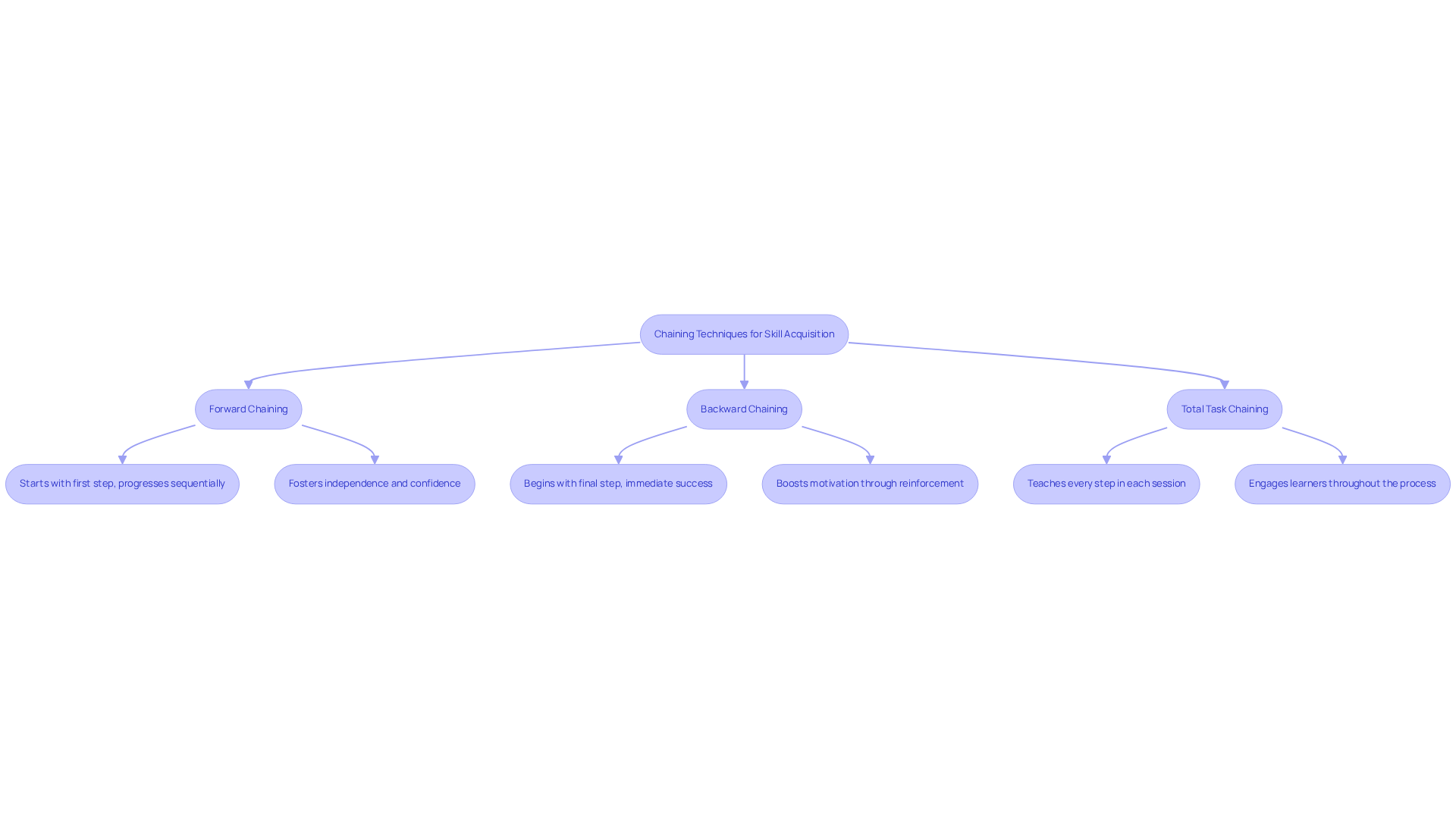
are crucial for breaking down complex tasks into manageable, sequential steps. This approach enables clients to master each component before tackling the entire task, fostering independence and confidence. Did you know that can significantly enhance a learner's self-sufficiency in daily routines?
The three primary methods - , , and - each offer unique advantages. In , the learner starts with the first step of a task, gradually progressing to subsequent steps as each is mastered. Conversely, begins with the final step, allowing the learner to experience immediate success and reinforcement, which can boost motivation and confidence. For instance, research indicates that Katie mastered the nine-step forward-chaining motor sequence in 18 fewer trials than the backward-chaining motor sequence, showcasing the efficiency of these methods. involves teaching every step of the task in each session, providing a comprehensive approach that engages learners throughout the entire process.
are evident in . For example, when teaching a child to brush their teeth, might involve first mastering the step of applying toothpaste, while would start with rinsing the mouth after brushing. Studies show that both forward and effectively support skill acquisition, with learners often achieving mastery more quickly through these structured approaches. This evidence-based technique not only fosters independence but also builds confidence, as learners experience success at each mini-task, ultimately leading to greater self-sufficiency in daily routines.
To enhance the effectiveness of , . This partnership can help determine the best method tailored to each learner's needs, ensuring a more effective and personalized approach to skill development.
are essential for reinforcing until the desired outcome is achieved. Consider this: when a child is learning to say 'hello,' a therapist might first reinforce any vocalization. Then, they focus on reinforcing attempts that resemble 'hello,' ultimately rewarding the correct pronunciation. This gradual approach not only builds confidence but also fosters competence in new skills, making it a highly effective strategy for .
Are you facing challenges in your ? Understanding the nuances of can significantly enhance your . By employing these techniques, you can ensure that your team is equipped with the skills necessary to support clients effectively.
Incorporating into your practice can lead to remarkable outcomes. As you reflect on your current , consider how these strategies can transform your approach. Embrace the opportunity to and drive success in your organization.

In today's competitive landscape, the demand for is skyrocketing. offers a comprehensive suite of resources tailored specifically for supervisors in the ABA field. These resources, which include:
are designed to elevate the .
By leveraging these tools, BCBAs can streamline their . This not only ensures but also enhances overall service delivery. Imagine having access to a network of professionals through , fostering collaboration and knowledge sharing that can lead to improved client outcomes.
Are you facing challenges in your current hiring process? Consider how can address these issues. With our platform, you can and access the resources necessary to support your effectively.
Take action today. Explore how can transform your and contribute to better outcomes for your clients.
Effective ABA supervision is crucial in today’s landscape, where the demand for Board Certified Behavior Analysts (BCBAs) continues to rise. This article has outlined ten essential checklist items that are key to successful supervision in Applied Behavior Analysis (ABA). By emphasizing structured data collection, interpretation, and teaching strategies, supervisors can significantly enhance the quality of interventions and improve client outcomes.
Consider the impact of continuous and discontinuous measurement techniques. These methods provide a solid foundation for informed decision-making and timely intervention adjustments. Furthermore, preference assessments, ABC data collection, and teaching methods like Discrete-Trial Teaching (DTT) and naturalistic approaches are vital for customizing therapy to meet the unique needs of each client. Techniques such as chaining and shaping not only support skill acquisition but also foster greater independence and confidence in learners.
As ABA practitioners, it’s essential to continually refine your skills and knowledge in these areas. Embracing these strategies elevates the effectiveness of supervision and contributes to the overall success of clients in therapy. Are you staying informed about current trends and resources? Engaging with platforms like Hire ABA can be a game-changer for practitioners aiming to provide the highest standard of care. Don’t miss out on the opportunity to enhance your practice-explore how Hire ABA can support your recruitment needs today.
What are continuous measurement techniques in ABA therapy?
Continuous measurement techniques involve monitoring every occurrence of an action within a specified timeframe, using methods like frequency counts, duration recording, and event recording to provide a comprehensive view of activity patterns.
How do frequency counts work in continuous measurement?
Frequency counts measure how often a child participates in a target action, such as repeating a stimming motion multiple times during an observation period.
What insights does duration recording provide?
Duration recording captures how long a specific action persists, such as a child engaging in stimming for 30 minutes or a temper tantrum lasting five minutes.
Why are continuous measurement techniques important in ABA therapy?
These techniques are essential for evaluating the effectiveness of interventions and making necessary adjustments to treatment plans, ensuring that interventions are tailored to individual needs.
What challenges can arise with continuous measurement techniques?
Inconsistent recording can occur without clear systems in place for information collection, which can affect the accuracy of data.
What are discontinuous measurement strategies?
Discontinuous measurement strategies involve sampling actions at specific intervals when continuous observation isn't feasible, allowing practitioners to gather meaningful data without constant monitoring.
What are some common methods of discontinuous measurement?
Common methods include partial interval recording, whole interval recording, and momentary time sampling.
How does partial interval recording work?
In partial interval recording, the observer notes whether an action occurred at any point during the interval, which can capture high-frequency actions but may lead to overestimations.
What is whole interval recording?
Whole interval recording requires that actions last for the entire duration of the interval, making it ideal for measuring sustained activities, but it may underestimate occurrences due to its stringent criteria.
What recent findings suggest about interval length in discontinuous measurement?
Studies indicate that shorter intervals, typically between 2 to 5 minutes, yield more accurate results and better alignment with continuous measures.
Why is data and graph interpretation important in ABA?
Interpreting data and graphs helps identify trends and patterns, enabling supervisors to evaluate the effectiveness of interventions and make informed, evidence-based decisions.
What types of graphs are commonly used in ABA?
Common types of graphs include line graphs, bar charts, and scatter plots, each providing different insights into behavior trends and treatment effectiveness.
How does family participation impact ABA therapy outcomes?
Family involvement is crucial as it provides therapists with insights into the individual's needs and progress, enhancing the overall effectiveness of the therapy.
What resources can help with graphing issues in ABA?
Tools like the Fix-It Table can assist in resolving common graphing issues, improving clarity and effectiveness in visual representation of data.
Our expert recruitment strategies and AI-driven sourcing ensure that you receive top-notch candidates quickly, without compromising on quality. Whether you’re looking for BCBAs, Clinical Directors, or RBTs, we’ve got you covered.


