


Thank you! Your submission has been received!
Oops! Something went wrong while submitting the form.
January 23, 2026

In the field of Applied Behavior Analysis (ABA), the precision of measurement techniques is crucial. Did you know that the demand for Board Certified Behavior Analysts (BCBAs) is skyrocketing? This highlights the need for effective intervention strategies. Continuous and discontinuous measurement methods each present unique advantages and challenges, shaping how practitioners assess behaviors and make informed decisions.
But how do you navigate the complexities of these approaches to select the most effective method for specific behaviors? Understanding the nuances of continuous versus discontinuous measurement is essential. It not only optimizes data collection strategies but also enhances the overall effectiveness of behavioral interventions.
Consider this: Are you currently facing challenges in hiring qualified professionals who can implement these measurement techniques effectively? Hire ABA can address these issues by connecting you with top talent in the field. With the right team in place, you can ensure that your interventions are based on solid data, leading to better outcomes for those you serve.
In the field of Applied Behavior Analysis (ABA), quantification plays a crucial role in assessing actions and evaluating interventions. Did you know that ? during a designated observation period, illustrating the concept of . This method provides comprehensive insights into frequency, duration, and intensity. For example, if a child raises their hand in class, ongoing tracking would document each instance seamlessly, ensuring no detail is overlooked.
On the other hand, the concept of indicates that intermittent observation captures samples of actions at specific intervals, meaning not every instance is recorded. This technique includes methods like , where the observer notes whether the action occurred at any point during predetermined intervals. based on the action being analyzed.
Are you facing challenges in ? Consider how Hire ABA can streamline your recruitment process. With a focus on reliability and expertise, our platform connects you with , ensuring your team is equipped to deliver the best outcomes for your clients.

In behavioral analysis, continuous , such as , , and rate calculations, are crucial for understanding . Have you ever wondered how these methods can enhance your understanding of behavior? For instance, involve tallying how many times an action occurs within a set timeframe, while tracks how long an action lasts. These techniques provide that can significantly inform your .
In contrast, the techniques, such as , document whether an action took place during the entire interval. indicates whether the action is happening at the conclusion of each interval. Each technique has its own application scenarios, and the shows that continuous approaches offer in-depth analysis while provide efficiency in busy environments.
As you consider your hiring challenges, think about how these can streamline your recruitment process. By integrating these methods, you can enhance your understanding of candidates' behaviors, ultimately leading to more informed . Embrace the power of continuous assessment to elevate your recruitment strategy.

Ongoing assessment is renowned for its precision and thorough data gathering, making it essential for tracking frequent actions or those requiring exact supervision. Yet, this method can be , demanding significant time and attention from observers-something that may not always be feasible in busy environments. For instance, while ongoing assessment is ideal for critical behaviors like aggression or self-harm, it may not be practical in settings where personnel are limited or multitasking is necessary.
Conversely, in real-world environments, particularly for actions that are infrequent or challenging to observe continuously. This method is less taxing on resources, enabling practitioners to collect data without overwhelming staff. However, it comes with its own challenges, such as the , as it samples occurrences rather than capturing every instance. For example, employing (PIR) may lead to inflated occurrence counts, while (MTS) can provide a snapshot of overall engagement but might miss critical details.
stress the . As one expert noted, 'Choosing between depends on what you’re tracking, your resources, and the behavior itself.' This insight underscores the necessity for practitioners to carefully evaluate their data collection strategies, balancing the need for accuracy with the practicalities of their working environment. Consistent training and oversight can help alleviate the constraints of both approaches, ensuring that information gathering remains reliable and efficient.

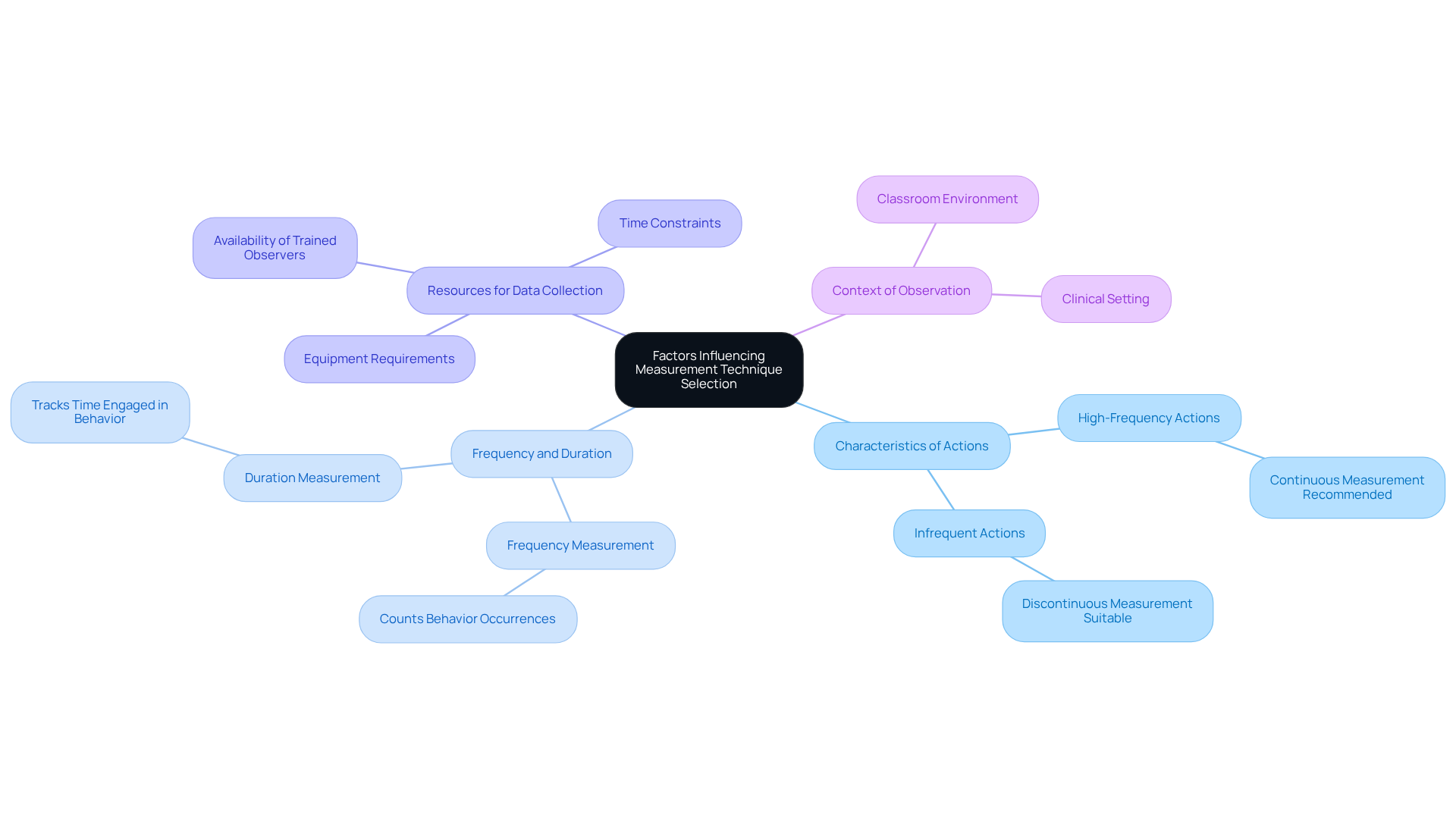
The choice of is influenced by several critical factors. These include the characteristics of the actions, their frequency and duration, and the resources available for data collection. For example, consider high-frequency actions like hand-raising in a classroom. These actions are often best recorded through , allowing for thorough monitoring of each instance. Conversely, infrequent actions, such as a child interrupting during a session, may be more effectively evaluated using that sample actions at specific intervals.
Moreover, the context of the observation is vital. Environments such as classrooms or clinics can impose practical constraints that favor techniques. Practitioners must carefully consider these factors to ensure their align with their intervention objectives and the specific traits of the behaviors being analyzed. This thoughtful approach not only enhances the accuracy of data collection but also supports the overall effectiveness of .
Are you facing challenges in hiring qualified (BCBAs)? Understanding the can significantly impact your recruitment strategy. By leveraging platforms like , you can streamline your hiring process and ensure you have the right professionals to meet your needs.
In the field of Applied Behavior Analysis (ABA), the demand for Board Certified Behavior Analysts (BCBAs) is on the rise. Understanding the distinctions between continuous and discontinuous measurement is crucial for effective behavior assessment and intervention. Continuous measurement offers a comprehensive account of behaviors, capturing every instance and providing insights into frequency, duration, and intensity. On the other hand, discontinuous measurement facilitates practical data collection in busy environments, though it may overlook critical details.
Key comparisons reveal the strengths and weaknesses of both measurement approaches:
The choice of measurement technique should be informed by the nature of the behavior, the context of observation, and the available resources, ensuring that data collection aligns with intervention goals.
Ultimately, the effectiveness of ABA interventions hinges on the careful selection of measurement techniques. Are you assessing your specific needs and constraints? Balancing accuracy with practicality is essential. By embracing a nuanced understanding of continuous and discontinuous measurement, behavior analysts can enhance their strategies, leading to better outcomes for clients. Consider how Hire ABA can support your recruitment efforts, ensuring you have the right professionals to meet these challenges head-on.
What is continuous measurement in Applied Behavior Analysis (ABA)?
Continuous measurement in ABA involves meticulously monitoring each occurrence of an action during a designated observation period, providing comprehensive insights into frequency, duration, and intensity of behaviors.
Can you give an example of continuous measurement?
An example of continuous measurement is tracking how many times a child raises their hand in class, documenting each instance to ensure no detail is overlooked.
What is discontinuous measurement in ABA?
Discontinuous measurement captures samples of actions at specific intervals, meaning not every instance is recorded. It includes methods like partial interval recording, where the observer notes whether the action occurred at any point during predetermined intervals.
Why is understanding continuous and discontinuous measurement important for professionals in ABA?
Understanding these definitions is vital for professionals to select the most appropriate assessment technique based on the action being analyzed, which can enhance intervention outcomes.
How can Hire ABA assist in hiring Board Certified Behavior Analysts (BCBAs)?
Hire ABA can streamline the recruitment process by connecting organizations with qualified BCBAs, ensuring teams are equipped to deliver the best outcomes for clients.
Our expert recruitment strategies and AI-driven sourcing ensure that you receive top-notch candidates quickly, without compromising on quality. Whether you’re looking for BCBAs, Clinical Directors, or RBTs, we’ve got you covered.


