


Thank you! Your submission has been received!
Oops! Something went wrong while submitting the form.
January 25, 2026

Differential Reinforcement of Alternative actions (DRA) and Differential Reinforcement of Other actions (DRO) are crucial strategies in Applied Behavior Analysis (ABA) therapy, designed to promote positive behavioral changes. Understanding the differences between these approaches is essential for practitioners aiming to select the most effective interventions. But how can caregivers and educators create supportive environments for individuals facing behavioral challenges? By exploring the core concepts, practical applications, and effectiveness of DRA and DRO, we uncover insights that can significantly enhance behavioral management strategies.
In a field where the demand for Board Certified Behavior Analysts (BCBAs) is ever-increasing, mastering these techniques is not just beneficial - it's imperative. The right approach can transform challenges into opportunities for growth, fostering an environment where individuals can thrive. Are you ready to navigate the complexities of behavioral management? Let’s delve deeper into these methodologies and discover how they can empower your practice.
vs is a powerful strategy that reinforces a specific alternative action, effectively serving the same function as the undesired behavior. For instance, consider a child who typically shouts to gain attention. A therapist might reinforce the child for raising their hand instead. This approach not only but also significantly .
Conversely, of Other actions (DRO) focuses on over a designated period. Take, for example, a child who frequently leaves their seat during class. A DRO procedure could involve if the child remains seated for a predetermined time. This method does not instruct a specific alternative action; rather, it seeks to by rewarding its non-occurrence.
Both are essential tools in , providing effective solutions for fostering positive behavior while reducing undesirable actions.

In educational settings, the comparison of is often employed to . For instance, a teacher might reinforce students who seek assistance rather than those who call out answers. This strategy not only encourages but also cultivates a more .
On the other hand, the concept of [](https://hireaba.today) is commonly utilized in . A therapist may implement DRO by rewarding a child for during a 10-minute session, gradually extending the duration as the child learns to manage their behavior. This method effectively without explicitly directing an alternative response.

The effectiveness of is particularly evident when a can be identified and taught. Its strength lies in fostering , making it an excellent choice for individuals who can learn and practice new actions. However, a notable limitation is that it necessitates the identification of a , which may not always be feasible.
In contrast, the comparison of shines in situations where pinpointing a is challenging. Its strength is rooted in its simplicity and ease of implementation, focusing on reinforcing the . Yet, a is that it may if not carefully monitored, as it does not specify which actions should be encouraged.
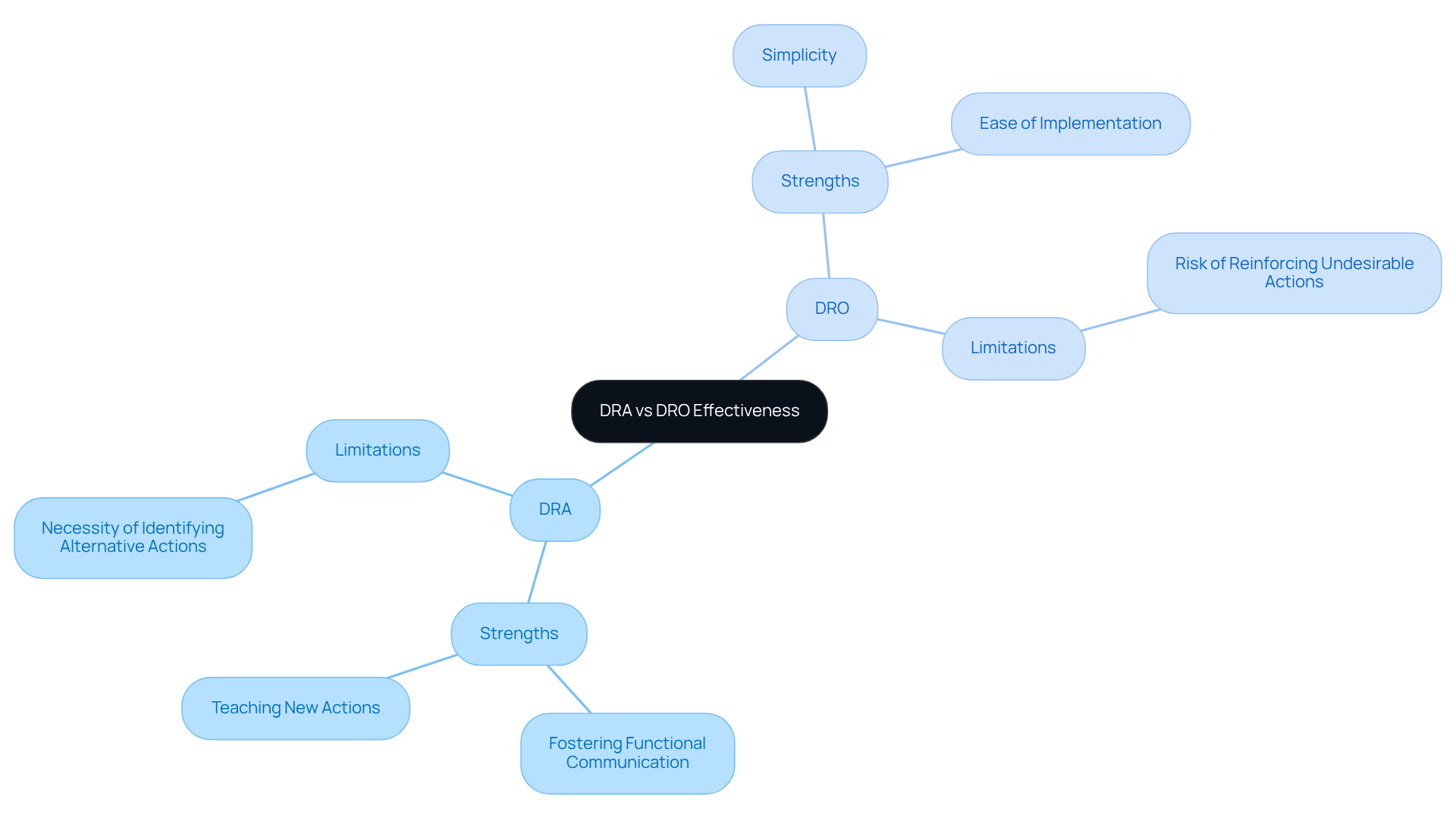
When deciding between and DRO, practitioners must consider several critical factors:
By reflecting on these factors, practitioners can make informed decisions that enhance the effectiveness of their interventions.

Differential Reinforcement of Alternative actions (DRA) and Differential Reinforcement of Other actions (DRO) are not just strategies; they are essential tools in the realm of Applied Behavior Analysis (ABA) therapy. Understanding these methods is vital for effectively managing behaviors, as each serves a unique purpose in promoting positive conduct while minimizing undesirable actions.
Why is this important? DRA focuses on teaching an appropriate alternative behavior, while DRO emphasizes reinforcing the absence of a specific unwanted behavior over a designated timeframe. This distinction is crucial. DRA shines when a clear alternative can be taught, making it particularly effective in various scenarios. On the other hand, DRO proves advantageous in settings where identifying such alternatives is challenging. By exploring the strengths and limitations of each method, practitioners gain a comprehensive view of their effectiveness.
So, how do you choose between DRA and DRO? The decision hinges on several factors:
By carefully considering these elements, practitioners can enhance their interventions and foster a more conducive environment for behavioral change.
Embracing these strategies empowers practitioners in their approach to behavior management. It significantly benefits those they serve, paving the way for improved outcomes in ABA therapy. Are you ready to elevate your practice? Consider how DRA and DRO can transform your interventions and lead to lasting behavioral change.
What is Differential Reinforcement of Alternative actions (DRA)?
DRA is a strategy in ABA therapy that reinforces a specific alternative action that serves the same function as an undesired behavior. For example, a child who shouts for attention may be reinforced for raising their hand instead.
How does DRA help in behavior management?
DRA promotes the development of more suitable actions while significantly decreasing the frequency of troublesome behaviors by providing reinforcement for alternative actions.
What is Differential Reinforcement of Other actions (DRO)?
DRO is a strategy that encourages the absence of a specific unwanted action over a designated period. It focuses on reinforcing the non-occurrence of the undesired behavior rather than instructing a specific alternative action.
Can you provide an example of how DRO works?
An example of DRO is when a child who frequently leaves their seat during class is reinforced for remaining seated for a predetermined amount of time, thereby aiming to reduce the unwanted behavior.
What are the benefits of using DRA and DRO in behavior management?
Both DRA and DRO are essential tools that provide effective solutions for fostering positive behavior while reducing undesirable actions in various settings.
Our expert recruitment strategies and AI-driven sourcing ensure that you receive top-notch candidates quickly, without compromising on quality. Whether you’re looking for BCBAs, Clinical Directors, or RBTs, we’ve got you covered.


