


Thank you! Your submission has been received!
Oops! Something went wrong while submitting the form.
March 4, 2026

Response maintenance stands as a cornerstone of effective Applied Behavior Analysis (ABA) therapy, yet it often receives less attention than it truly deserves. This crucial aspect ensures that individuals not only retain but also apply learned skills independently over time, significantly enhancing their quality of life. But how can practitioners effectively implement strategies to ensure these skills stick?
Exploring the intricacies of response maintenance reveals a wealth of techniques and insights that can transform therapeutic outcomes. It invites practitioners to rethink their approaches for lasting success. Are you ready to elevate your practice and ensure that the skills you teach truly make a difference? Let's delve into the strategies that can lead to remarkable results.
Response maintenance ABA practice is crucial. It refers to an individual's ability to remember and execute learned skills over time without the need for constant cues or interventions. This concept is vital as it highlights the effectiveness of therapeutic interventions and the learner's ability to apply skills in various contexts.
Research indicates that skills retained over time contribute to greater independence and an improved quality of life for those undergoing ABA treatment. For instance, consider a child who learns to ask for help in a structured environment. Ideally, this child should be able to use that skill in different settings, such as at home or in school, without ongoing support.
A study revealed that children receiving intensive ABA intervention - averaging 25 to 40 hours per week - showed significant improvements in cognitive, language, and social development. This underscores the necessity of consistent practice and reinforcement. By prioritizing response maintenance ABA, practitioners can ensure that the time and effort spent teaching skills result in lasting benefits, ultimately leading to more successful therapy outcomes.

To promote response maintenance in Applied Behavior Analysis (ABA), practitioners can implement several effective strategies that significantly enhance the durability of acquired behaviors:
Fading Prompts: Gradually reducing the use of prompts as the individual becomes more proficient encourages independence. This approach assists learners in relying on their abilities rather than external cues, promoting long-term retention of learned behaviors. Research shows that higher mastery criteria result in improved retention of abilities, highlighting the significance of this method.
Varying Reinforcement Schedules: Utilizing intermittent reinforcement, rather than providing rewards every time a behavior occurs, strengthens behaviors over time. This strategy mirrors natural learning environments, where rewards are not consistently available, thereby enhancing the durability of the behavior. Research indicates that over 89% of youngsters receiving ABA treatment experience considerable advancements, underscoring the efficacy of diverse reinforcement.
Natural Environment Training: Practicing abilities in varied settings and situations improves generalization. For instance, if a young person learns to ask for a snack during a counseling session, practicing this ability in different places - like at home or during outings - strengthens its application in real-life situations. This method aligns with findings that children engaged in early, intensive therapy often experience meaningful developmental progress.
Periodic Ability Probes: Regular evaluations of the student's capacity to demonstrate competencies without prompts help identify areas needing reinforcement. This continuous assessment ensures that abilities remain refined and that the learner continues to advance. Incorporating feedback from these assessments can guide practitioners in refining their approaches.
By utilizing these strategies, practitioners can significantly improve response maintenance in ABA, ensuring that acquired behaviors are retained and generalized across various environments. The success of ABA therapy, endorsed by organizations like the US Surgeon General, underscores the importance of these evidence-based practices. Are you ready to enhance your ABA practice with these proven strategies?

To optimize response maintenance ABA techniques, practitioners must engage in ongoing evaluations and adjustments. This is not just a recommendation; it’s essential for effective practice. Consider this: systematic tracking of an individual's performance over time is crucial for identifying trends in skill retention and application. Accurate data collection methods - like frequency, duration, and latency recording - provide insights that inform decisions on when to modify strategies.
Establishing regular communication with caregivers and other stakeholders is vital for gathering insights on the student's performance in natural settings. Therapists rely on real-time data to make necessary adjustments. This feedback can illuminate areas where additional support may be necessary, enhancing the effectiveness of interventions.
Practitioners should be prepared to adapt strategies based on the student's progress. If a particular technique fails to yield the desired results, exploring alternative methods or additional supports can lead to better outcomes. A case study demonstrated that altering strategies based on data gathering resulted in notable enhancements in a young person's involvement and application of abilities.
Establishing explicit mastery standards for abilities and modifying them as the individual advances is essential. For instance, if a child consistently shows proficiency, raising the criteria for mastery ensures continued growth and development. Utilizing trial-by-trial or frequency methods to assess mastery can provide a clearer picture of the learner's progress.
By continuously evaluating and adjusting these techniques, practitioners can achieve response maintenance ABA to maintain the effectiveness of their interventions. This commitment ultimately supports long-term success in skill retention and application.

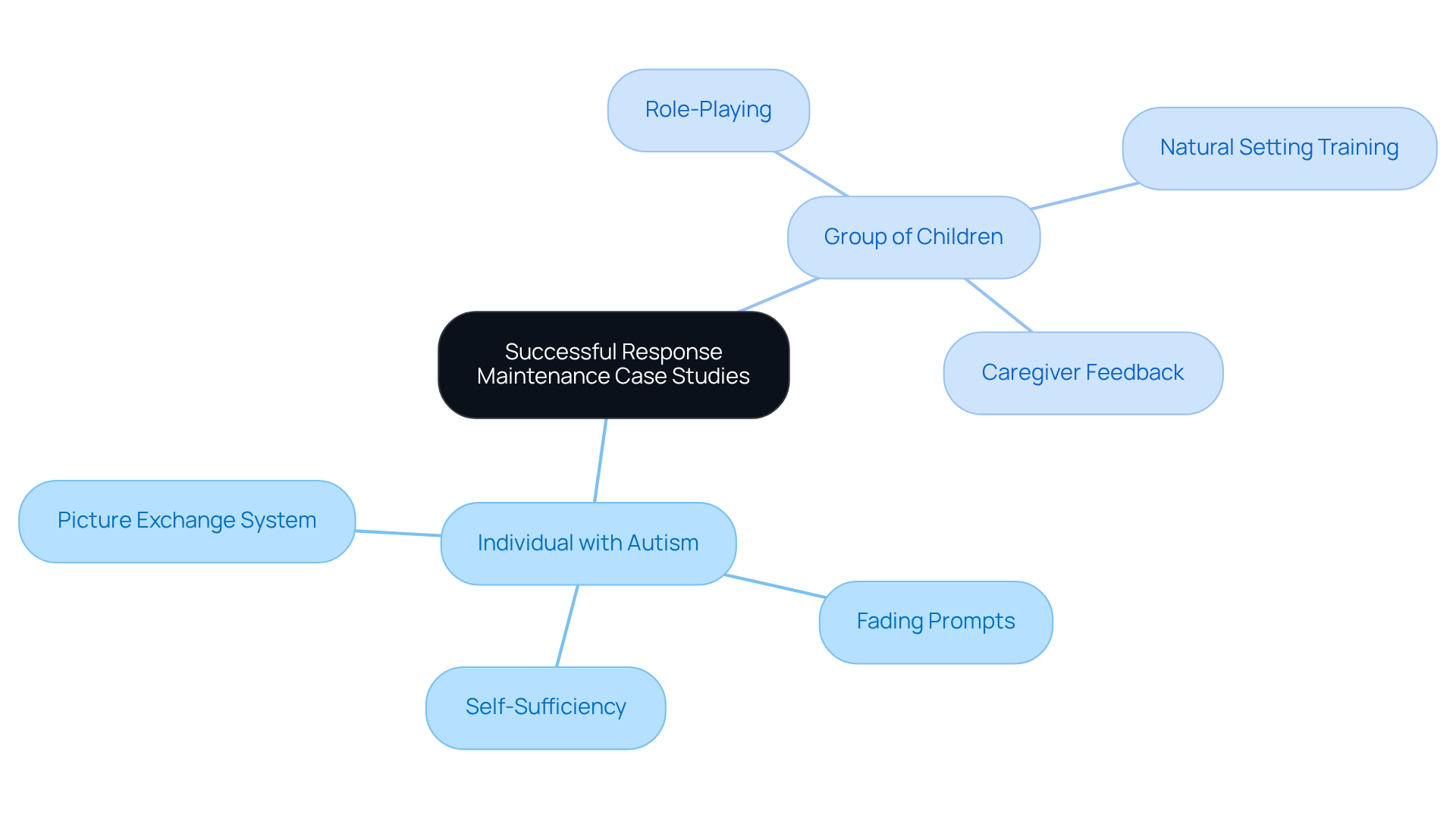
Case studies provide crucial insights into the practical application of response maintenance ABA strategies in therapy. For instance, one case involved a young individual with autism who learned to request help using a picture exchange system. Initially, this young person needed frequent prompts and reinforcement. However, through the application of fading prompts and adjustments to reinforcement schedules, they gradually became more self-sufficient in utilizing this skill. Over six months, the individual was able to request assistance in various settings, including at home and during playdates, showcasing effective response maintenance.
Another case study highlighted a group of children who were taught social skills through role-playing and natural setting training. By regularly assessing their performance and adapting strategies based on caregiver feedback, these children maintained their social skills over time, leading to improved interactions with peers.
These examples underscore the effectiveness of response maintenance ABA strategies in achieving meaningful outcomes in ABA therapy. Are you ready to explore how these strategies can enhance your practice?
Response maintenance stands as a pivotal element in Applied Behavior Analysis (ABA) therapy, underscoring the necessity of sustaining learned skills over time without relying on constant cues. This principle not only showcases the effectiveness of therapeutic interventions but also reveals the potential for individuals to apply their skills in diverse settings, ultimately promoting greater independence and enhancing their quality of life.
Throughout this discussion, several key strategies for fostering response maintenance have been highlighted. These include:
Each of these methods is crafted to bolster the retention and generalization of skills, ensuring that the advantages of ABA therapy reach far beyond the confines of the therapy room. Moreover, the continuous evaluation and adjustment of techniques are crucial, emphasizing the need for data-driven practices that can adapt to the evolving needs of learners.
In conclusion, the effective implementation of response maintenance strategies in ABA therapy is vital for achieving meaningful outcomes. By prioritizing these evidence-based practices, practitioners can significantly enhance the durability of learned behaviors, leading to improved independence and a higher quality of life for individuals receiving ABA services. Embracing these strategies not only benefits the learners but also contributes to the overall success and credibility of the ABA practice. Are you ready to elevate your practice and ensure lasting impact? The time to act is now.
What is response maintenance in ABA therapy?
Response maintenance in ABA therapy refers to an individual's ability to remember and execute learned skills over time without the need for constant cues or interventions.
Why is response maintenance important in ABA therapy?
It is important because it highlights the effectiveness of therapeutic interventions and the learner's ability to apply skills in various contexts, contributing to greater independence and an improved quality of life.
Can you provide an example of response maintenance in action?
An example is a child who learns to ask for help in a structured environment and is then able to use that skill in different settings, such as at home or in school, without ongoing support.
What does research say about the effects of intensive ABA intervention on children?
Research indicates that children receiving intensive ABA intervention, averaging 25 to 40 hours per week, show significant improvements in cognitive, language, and social development.
How does consistent practice and reinforcement relate to response maintenance?
Consistent practice and reinforcement are necessary for ensuring that the skills taught during therapy result in lasting benefits, leading to more successful therapy outcomes.
Our expert recruitment strategies and AI-driven sourcing ensure that you receive top-notch candidates quickly, without compromising on quality. Whether you’re looking for BCBAs, Clinical Directors, or RBTs, we’ve got you covered.


