


Thank you! Your submission has been received!
Oops! Something went wrong while submitting the form.
December 6, 2025

Conditioned responses are a captivating facet of both human and animal behavior, illustrating how learned associations shape our reactions to the world around us. Consider this: through classical conditioning, as demonstrated in Pavlov's renowned experiments, neutral stimuli can evoke profound responses. This powerful mechanism not only sheds light on behavioral patterns but also raises critical questions about its implications in our daily lives, therapeutic practices, and even consumer behavior.
How do these learned reactions influence your personal experiences and societal interactions? What strategies can be employed to modify these responses for more favorable outcomes? Understanding the dynamics of conditioned responses is essential for anyone looking to navigate the complexities of behavior, whether in a clinical setting or in everyday situations.
By exploring these questions, we can uncover the potential for positive change and growth, both personally and within our communities.
A learned behavior (CR) is a behavior that occurs in reaction to a previously neutral event after it has been paired with an unconditioned event (US). This fundamental aspect of illustrates how a neutral factor can trigger an effect that does not naturally occur. Pavlov's experiment serves as an example of , where dogs learned to salivate (the ) at the sound of a bell (the learned cue) after the bell was consistently associated with food (the unconditioned stimulus).
Recent studies have expanded our understanding of , revealing their prevalence in everyday life. For instance, phobias often emerge from . An individual might develop a fear of dogs after being bitten, showcasing how s can significantly influence behavior.
Importantly, are not permanent; they can evolve with new experiences and knowledge. Research indicates that can persist for up to a year, highlighting the lasting impacts of conditioned behaviors. Understanding these reactions is crucial for therapeutic practices, as they can be modified through approaches like (CBT). CBT emphasizes recognizing triggers and replacing negative reactions with healthier alternatives.
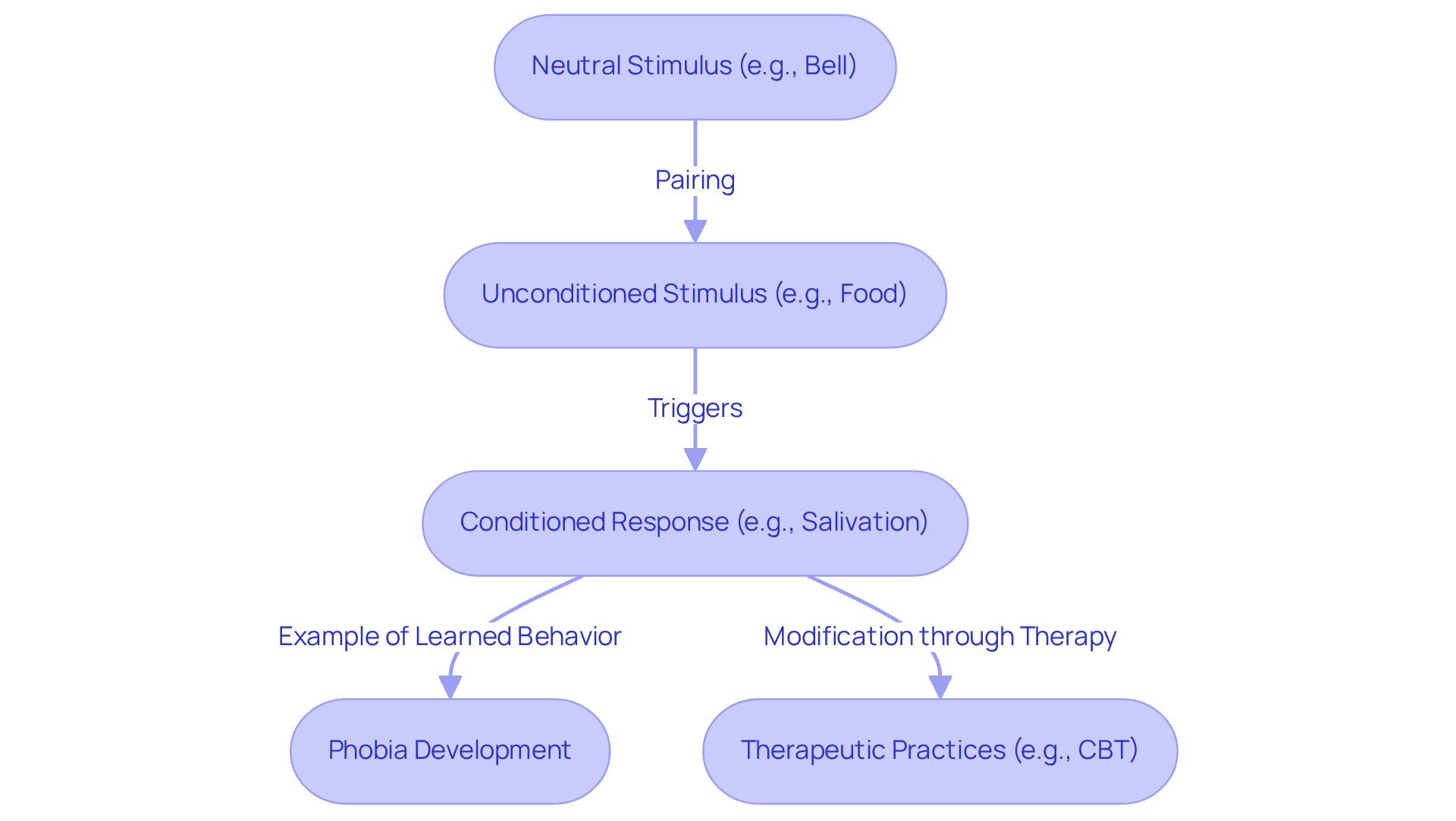
play a pivotal role in , a learning process first articulated by Ivan Pavlov in the early 20th century. In this framework, a neutral signal is paired with an unconditioned factor that naturally elicits a response. Over time, the neutral cue evolves into a conditioned cue, serving as an example of by triggering the on its own. This process underscores the power of , where organisms learn to link cues and respond accordingly. The are profound, impacting fields such as psychology, education, and therapy by illustrating how behaviors can be modified through .
Consider this: a cat learns to associate the sound of an electric can opener (the learned signal) with receiving food (the natural signal), leading to an enthusiastic response (the learned reaction). This scenario is an example of , where a previously established stimulus is paired with a new neutral stimulus to elicit a reaction. In , practitioners harness principles to reshape maladaptive behaviors. Techniques like systematic desensitization leverage to help individuals confront and overcome their fears.
In educational settings, manifests when students connect specific signals, such as the ringing of a bell, with the start of a lesson, fostering a learned behavior of attentiveness. Ongoing research in continues to explore its applications, including taste aversion, which serves as an evolutionary mechanism to avoid harmful substances.
The influence of on is significant. For instance, a child may exhibit excitement upon seeing a familiar formula canister, which serves as an example of , as they associate it with the unconditioned cause of food. This illustrates how can shape actions and reactions in everyday life. As Ivan Pavlov noted, 'The neutral signal transformed into the conditioned signal (CS), which is an entity that provokes a reaction after being consistently associated with an unconditioned signal.' Ultimately, remains a vital area of research, revealing the intricate ways in which learning influences behavior.

Understanding is crucial for professionals in therapy. These instinctive behaviors occur automatically in response to unconditioned triggers, without any prior learning. For instance, consider a dog salivating when presented with food - this illustrates a natural reflex that is fundamental to behavioral science.
In contrast, learned reactions develop from the association between a neutral stimulus and an unconditioned stimulus. Take the example of , which is when a dog begins to salivate at the sound of a bell after several pairings with food. This salivation serves as an example of . Recognizing these distinctions is vital for ABA practitioners, as the modification of behaviors through conditioning is a core practice in the field.
Recent research underscores the importance of identifying . These automatic reactions can significantly inform treatment strategies. For example, like yelping in pain after stepping on a nail or laughing at a funny face highlight the innate nature of these responses. Furthermore, current studies in emphasize the role of an in crafting effective interventions. Organized ABA programs have demonstrated substantial improvements in , empowering individuals to achieve greater independence.
Children who undergo before the age of five often show remarkable advancements in communication, social skills, and adaptive behaviors. By integrating insights from behavioral research and employing data collection strategies, ABA professionals can refine their approaches. This ensures that interventions are tailored to individual needs and grounded in scientific understanding.
Are you facing challenges in hiring ? Consider how can streamline your recruitment process, connecting you with top talent in the field. With a focus on reliability and expertise, is your partner in building a skilled team that can make a difference.

Conditioned behaviors are evident in various aspects of daily life, illustrating their widespread influence. Pavlov's experiment is a classic example of , where dogs learned to salivate at the sound of a bell after it was consistently paired with food. This phenomenon is an example of , demonstrating how connections can develop between triggers and reactions. For instance, a child who is bitten by a dog might develop a fear of dogs, which serves as an example of , where the appearance of a dog (triggering stimulus) provokes fear (learned reaction) even when there is no danger.
In marketing, are strategically utilized to stimulate consumer actions. Have you ever noticed how you crave specific foods upon hearing jingles associated with particular restaurants? This showcases how advertising exploits these learned associations to drive sales.
Recent case studies reveal that children can form through exposure to media and marketing, where repeated associations can lead to preferences or dislikes. Understanding these reactions, which serve as an , is crucial, not only in therapeutic settings but also in .
The impact of learned behaviors extends into therapy, where methods like . By progressively introducing patients to anxiety-inducing stimuli while employing relaxation techniques, therapists can assist in altering learned behaviors, resulting in enhanced emotional control.
Moreover, a systematic review involving over 292,000 children found that , such as anxiety and aggression. Michael Noetel, PhD, noted that increased screen time can lead to emotional and behavioral issues, emphasizing the need for a nuanced approach to managing children's screen time. Overall, the pervasive nature of s serves as an example of that underscores their significance in both therapeutic practices and marketing strategies.
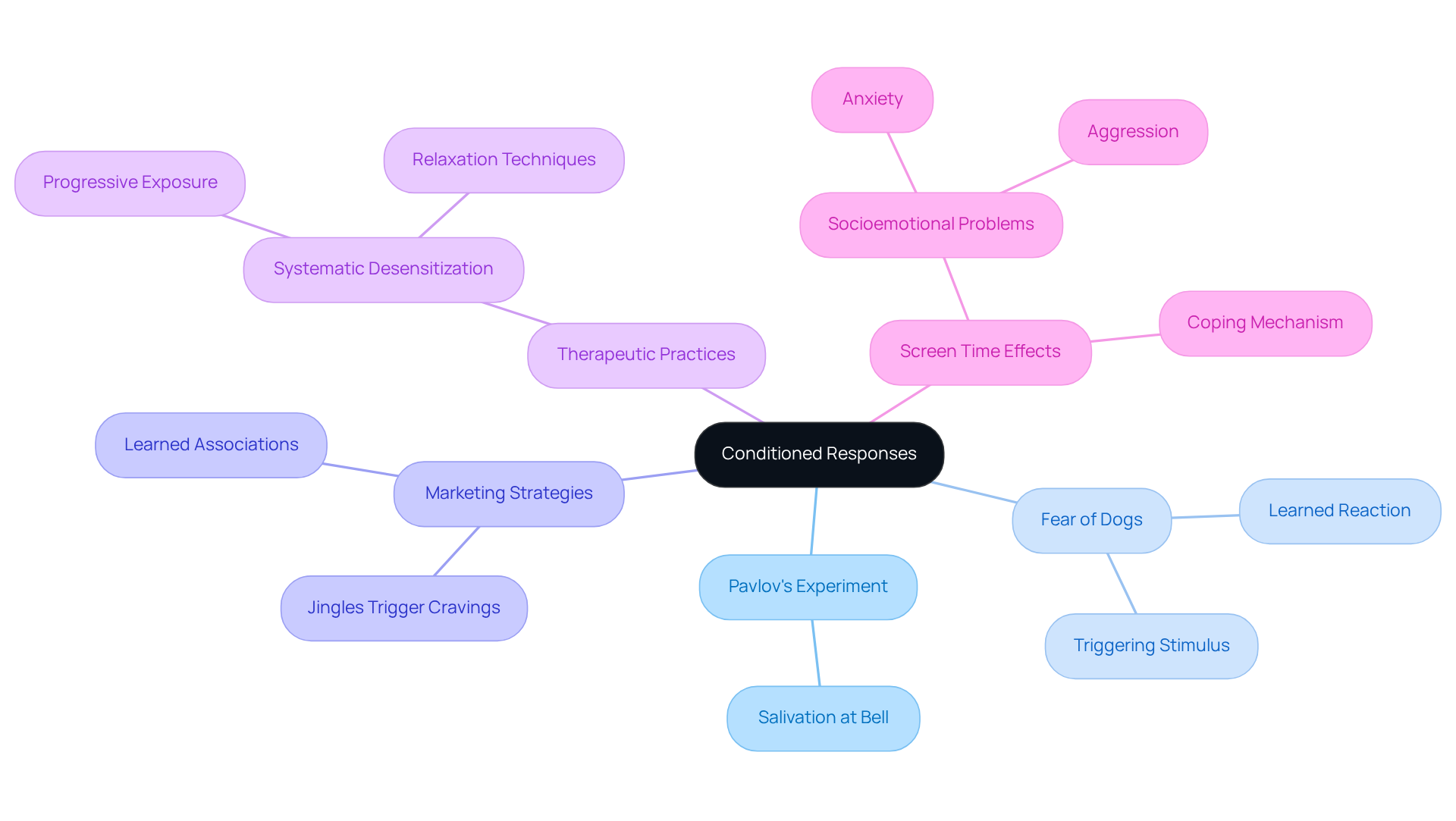
Conditioned responses stand at a compelling crossroads of learning and behavior, showcasing how neutral stimuli can trigger profound reactions through established associations. This understanding is crucial across various fields, particularly in psychology and therapy, where altering these learned behaviors can lead to transformative changes in individuals' lives.
As we delve into conditioned responses, several key insights come to light:
Recognizing the importance of conditioned responses invites a deeper reflection on how our experiences shape our behavior. In therapeutic settings or everyday interactions, the ability to identify and modify these responses empowers individuals to conquer fears and improve their emotional well-being. Embracing this knowledge paves the way for more effective strategies in personal development and behavioral change, emphasizing the critical role of understanding conditioned responses within the broader framework of human psychology.
What is a conditioned response?
A conditioned response (CR) is a learned behavior that occurs in reaction to a previously neutral event after it has been paired with an unconditioned event (US).
How does classical conditioning illustrate conditioned responses?
Classical conditioning demonstrates how a neutral factor can trigger a response that does not naturally occur. For example, in Pavlov's experiment, dogs learned to salivate at the sound of a bell after it was consistently associated with food.
Can you provide an example of a conditioned response in everyday life?
An example of a conditioned response in everyday life is the development of phobias. For instance, an individual may develop a fear of dogs after being bitten, illustrating how learned reactions can influence behavior.
Are learned behaviors permanent?
No, learned behaviors are not permanent; they can evolve with new experiences and knowledge.
How long can intrusive memories related to conditioned behaviors persist?
Research indicates that intrusive memories can persist for up to a year, highlighting the lasting impacts of conditioned behaviors.
Why is understanding conditioned responses important for therapeutic practices?
Understanding conditioned responses is crucial for therapeutic practices because they can be modified through approaches like cognitive-behavioral therapy (CBT), which focuses on recognizing triggers and replacing negative reactions with healthier alternatives.
Our expert recruitment strategies and AI-driven sourcing ensure that you receive top-notch candidates quickly, without compromising on quality. Whether you’re looking for BCBAs, Clinical Directors, or RBTs, we’ve got you covered.


