


Thank you! Your submission has been received!
Oops! Something went wrong while submitting the form.
March 2, 2026
The demand for Board Certified Behavior Analysts (BCBAs) is on the rise, highlighting the critical need for effective behavioral interventions. Understanding the dynamics of behavior can significantly enhance the effectiveness of therapeutic and educational strategies. ABC recording, a cornerstone of Applied Behavior Analysis, stands out as a powerful tool for practitioners. It allows them to document the interplay between antecedents, actions, and consequences, unraveling the complexities of client behaviors.
However, many professionals face challenges in fully harnessing this method. What obstacles might hinder the effective implementation of ABC recording? Overcoming these challenges can lead to significant improvements in behavioral assessment and intervention outcomes. By addressing these issues, practitioners can unlock the full potential of their interventions, ultimately benefiting their clients and enhancing their practice.
, or Antecedent-Behavior-Consequence recording, is a systematic method used in to observe and document the connection between environmental events and actions. This technique identifies three key components:
Why is this important? By capturing these elements, practitioners can analyze patterns and hypothesize about the function of specific actions. This makes ABC recording primarily used in and .
Are you facing challenges in understanding the behaviors of your clients? Consider how mastering ABC recording can . With this method, you can gain insights that lead to effective interventions.
In summary, ABC recording not only aids in but also empowers practitioners to implement strategies that foster positive change.

The crucial role of in highlights that is used primarily in functional analysis to uncover the reasons behind specific actions. Have you ever wondered why certain behaviors occur? ABC recording is used primarily in functional analysis, where practitioners gather data to identify the function of an action-whether it’s to gain attention, escape a situation, or satisfy a sensory need. By meticulously documenting antecedents, actions, and outcomes, analysts can develop that address the root causes of behaviors rather than merely treating their symptoms.
This method proves particularly effective in educational and therapeutic settings, where understanding actions is vital for crafting successful support strategies. Imagine the impact of having a clear grasp of why behaviors manifest. With this knowledge, you can implement strategies that truly make a difference.
Are you facing challenges in your current hiring practices? Consider how can , ensuring you find the right professionals equipped to utilize ABC documentation effectively. By leveraging our platform, you can enhance your team's capabilities and ultimately improve outcomes for those you serve.

The origins of are firmly anchored in behaviorism, particularly through the in the mid-20th century. Skinner's extensive research on laid the foundation for understanding how actions are influenced by their consequences. This insight paved the way for the ABC model, which analysts have since refined to create structured methodologies for evaluating and modifying behaviors.
is a systematic approach that records precursors, actions, and outcomes, enabling practitioners to efficiently analyze behavioral trends. Over the years, [ABC recording](https://hireaba.today/blog-posts/10-board-certified-behavior-analyst-online-programs-to-consider) has become a cornerstone of , allowing professionals to methodically examine actions across various contexts, including educational and clinical settings. For instance, in educational environments, ABC data gathering can reveal how specific triggers, like disengagement, lead to disruptive behaviors, thereby informing tailored .
As Kathleen Dyer aptly notes, 'A-B-C analysis considers actions as a function of the antecedents that come before it and the consequences that succeed it.' This structured methodology not only deepens our understanding of behavioral patterns but also guides the development of customized to meet individual needs. Are you ready to leverage the power of ABC recording to enhance your practice?

stands out due to its organized method, focus on observable actions, and contextual emphasis. This enables practitioners to consistently document data, which is crucial for identifying . By concentrating on visible actions, ABC recording reduces personal interpretations, ensuring that the data collected remains objective and reliable.
Moreover, the focus on -allows analysts to grasp the environmental factors influencing actions. This comprehensive methodology not only aids in identifying the functions of behaviors but also informs the development of effective, individualized , as ABC recording is used primarily in . Have you considered how structured ABC documentation could enhance your practice?
For instance, case studies reveal that organizations employing see significant improvements in , ultimately leading to better outcomes for clients. Current best practices in ABC documentation stress the importance of and collaboration with caregivers, ensuring that interventions are tailored to meet the unique needs of each child.
Research shows that structured training programs can lead to a 50% reduction in implementation-related errors, which demonstrates that ABC recording is used primarily in functional analysis. Are you ready to elevate your documentation practices and improve your outcomes? Embrace the power of ABC documentation today.
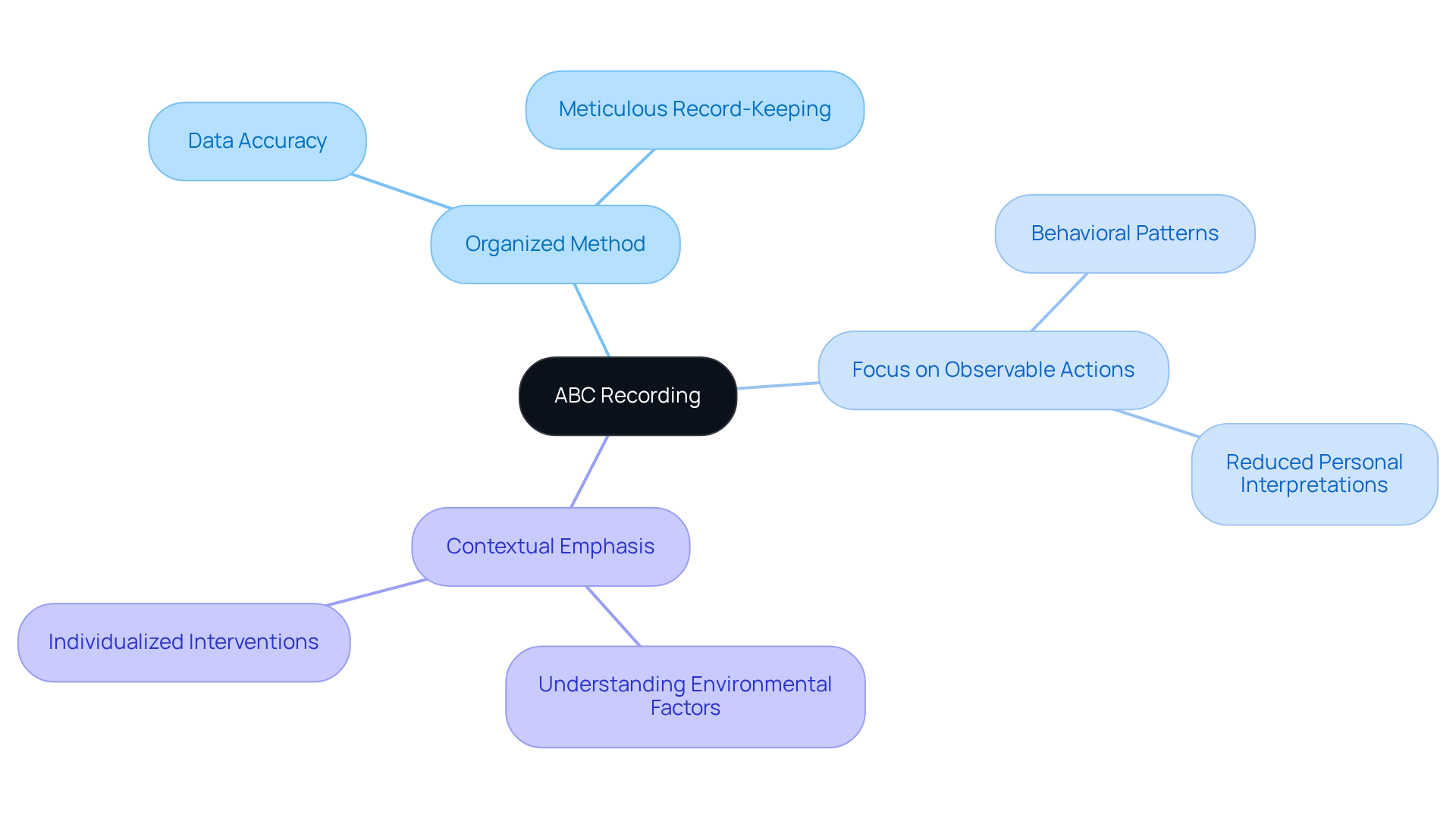
ABC recording stands as a cornerstone in functional analysis, showcasing the vital connection between environmental factors and behaviors. By meticulously documenting antecedents, behaviors, and consequences, practitioners unlock deep insights into the motivations driving specific actions. This understanding not only sharpens the analysis of behavior but also equips professionals to craft effective interventions tailored to individual needs.
The article delves into the origins, applications, and characteristics of ABC recording. From its roots in behaviorism and the groundbreaking work of B.F. Skinner to its current use in educational and therapeutic settings, ABC recording has become essential for practitioners seeking to address the root causes of behavior. By concentrating on observable actions and their contexts, this method guarantees that data remains objective and actionable, paving the way for improved outcomes for clients.
Embracing ABC recording transcends mere academic interest; it represents a pivotal step toward fostering positive behavioral change. As practitioners hone their skills in this methodology, they not only deepen their understanding of client behaviors but also contribute to the creation of more effective intervention strategies. The potential for meaningful change is within reach - leveraging ABC recording can revolutionize practice and ultimately enhance lives.
What is ABC recording in functional analysis?
ABC recording, or Antecedent-Behavior-Consequence recording, is a systematic method used in Applied Behavior Analysis (ABA) to observe and document the connection between environmental events and actions.
What are the three key components of ABC recording?
The three key components of ABC recording are the antecedent (what occurs before the action), the action itself (the observable act), and the consequence (what happens after the action).
Why is ABC recording important in functional analysis?
ABC recording is important because it allows practitioners to analyze patterns in behavior and hypothesize about the function of specific actions, which aids in developing effective intervention strategies.
How can mastering ABC recording benefit practitioners?
Mastering ABC recording can enhance a practitioner's ability to understand client behaviors, leading to insights that inform effective interventions and foster positive change.
Our expert recruitment strategies and AI-driven sourcing ensure that you receive top-notch candidates quickly, without compromising on quality. Whether you’re looking for BCBAs, Clinical Directors, or RBTs, we’ve got you covered.


