


Thank you! Your submission has been received!
Oops! Something went wrong while submitting the form.
March 23, 2026

Negative reinforcement plays a crucial role in shaping classroom dynamics, yet its nuances often remain misunderstood. By removing unpleasant stimuli, educators can effectively motivate students to engage in desired behaviors, thereby transforming the learning environment. However, the challenge lies in balancing these strategies to avoid fostering fear or anxiety.
What insights can help educators harness negative reinforcement to enhance student engagement? Consider how these strategies can create a more supportive educational atmosphere. By understanding the delicate balance of negative reinforcement, educators can foster a classroom environment that encourages participation and reduces anxiety.
As we delve deeper into this topic, it’s essential to reflect on your current classroom dynamics. Are you leveraging negative reinforcement effectively? How can these insights guide your approach to student engagement? Let's explore the potential of negative reinforcement in education.
is a technique that enhances a specific action by removing an unpleasant stimulus. For instance, when an instructor allows students to leave class early upon completing their tasks, this act exemplifies by removing the discomfort associated with staying, which reinforces the behavior of finishing assignments.
It’s crucial to understand that is not the same as punishment. Instead, it focuses on increasing the likelihood of a desired action by alleviating the discomfort linked to . This principle is rooted in operant conditioning, where behaviors are modified through their consequences. However, relying on punishment can lead to avoidance behaviors, withdrawal, or increased aggression. rather than fostering positive behavioral change.
The case study titled '' underscores that punishment may not effectively alter behaviors and advocates for the use of positive strategies to support student success. Therefore, educators should actively seek that enhance the learning environment.
Are you considering how to effectively manage classroom behavior? Explore that not only improve student engagement but also foster a more productive learning atmosphere.

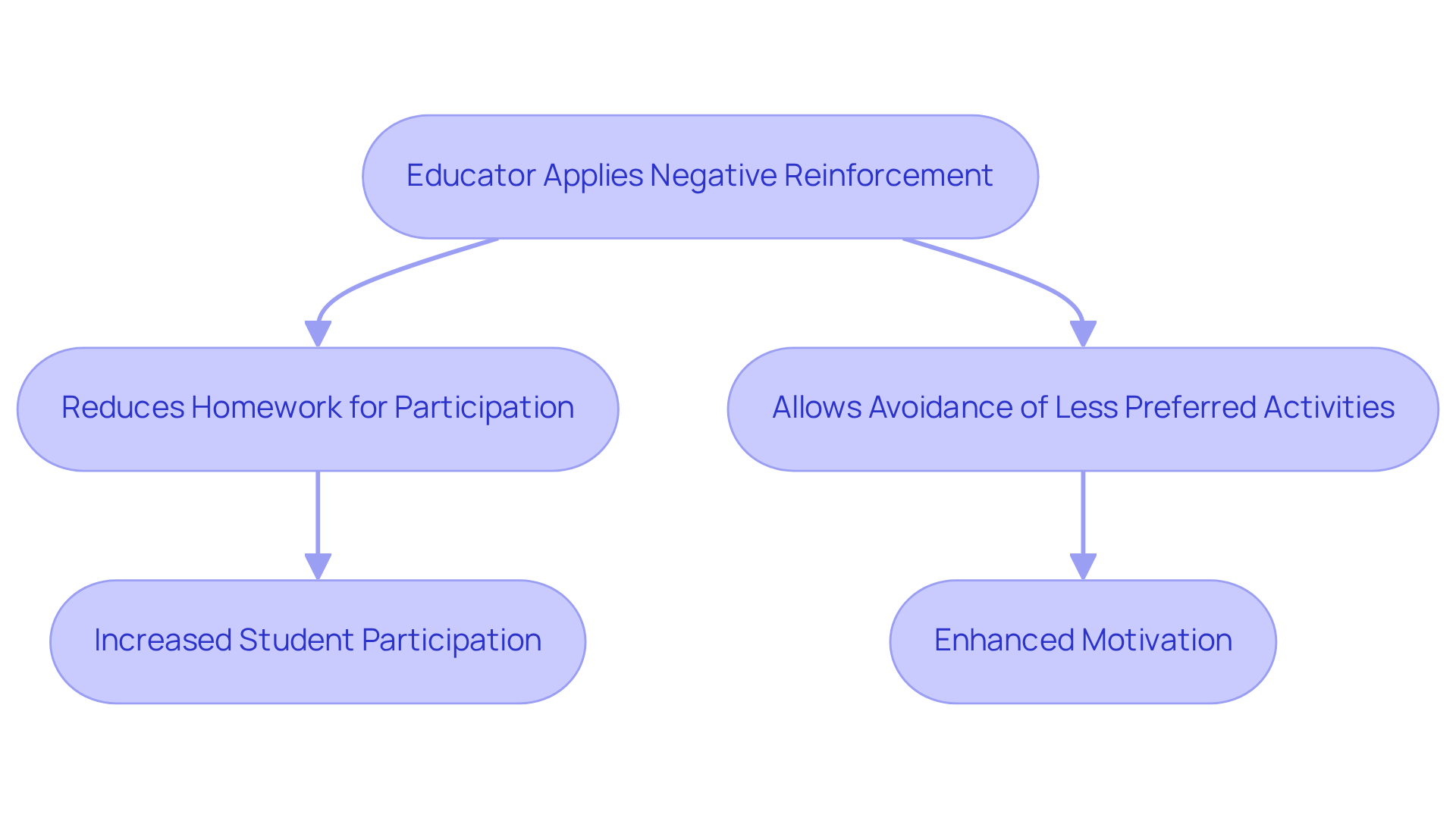
significantly shape learner conduct in education, fostering . Educators often face challenges with and compliance. By effectively applying , they can cultivate an environment where students are motivated to demonstrate . For example, consider an educator who reduces homework for students who actively participate in class discussions. This approach reinforces the notion that hard work can lead to less homework, encouraging participation and fostering independence among learners.
As highlighted by Twinkl, involves removing something undesirable in response to , which can greatly enhance learner motivation. Allowing students to avoid less preferred activities, such as early morning practices for improved sports performance, further strengthens s and nurtures a .
Understanding the importance of integrating both can lead to increased student involvement and improved conduct. This ultimately fosters a more effective educational experience. Are you ready to explore how these strategies can transform your classroom dynamics?
, laying the groundwork for understanding adverse feedback through his extensive research on operant conditioning in the mid-20th century. His findings reveal a compelling truth: actions can be modified by reinforcing preferred behaviors, with the removal of adverse stimuli playing a crucial role in fostering positive actions. For example, Skinner's experiments demonstrated that alleviating unpleasant consequences increases the likelihood of individuals repeating desired behaviors.
Educational psychologists have embraced this principle, incorporating while adapting Skinner's insights to implement that significantly enhance student engagement and . Consider the , which posits that a high-probability action can motivate a low-probability action. This further illustrates how .
However, it’s essential to recognize that while adverse stimuli can be effective, they may also lead to avoidance behaviors and fail to cultivate a . The underscores its importance as a foundational element in contemporary behavior modification techniques, particularly .
Reflect on your current strategies: Are they fostering a love for learning, or merely compliance? Understanding the balance of these approaches is vital for .

Negative reinforcement involves the removal of an unpleasant stimulus, which increases the likelihood of a desired action. For example, when a learner is allowed to skip a quiz after consistently completing assignments, the elimination of the quiz acts as a negative reinforcer, motivating the individual to continue their homework. This principle aligns with operant conditioning, where behaviors are influenced by their consequences.
However, educators must tread carefully when employing adverse stimuli. Misuse can foster an environment of fear or anxiety among students. A case study titled '' illustrates that while , it may not cultivate positive emotions or genuine learning, potentially leading to avoidance responses.
In contrast, the case study '' underscores the effectiveness of positive support strategies in enhancing classroom management and student interactions. This suggests that a , incorporating both and positive strategies, is essential for creating a supportive learning environment.
Furthermore, involving students in establishing classroom guidelines and recognizing good behavior through positive acknowledgment can significantly enhance the overall classroom experience. Are you ready to implement these strategies to foster a more engaging and effective learning atmosphere?

Practical instances of are crucial for effective management. Consider this: when students are allowed to exit class early after completing their assignments on time, it alleviates the discomfort of prolonged class duration. This is a prime example of in the classroom, where an unpleasant stimulus is removed to encourage positive behavior.
Moreover, for students who actively participate in class discussions eases the pressure associated with regular evaluations. This not only fosters a more engaging environment but also motivates students to contribute more.
Another effective strategy is allowing students to choose their seating arrangements after demonstrating . This approach eliminates the constraints of assigned seating, promoting a sense of autonomy and responsibility among learners.
These strategies illustrate how adverse stimuli can be effectively integrated into , encouraging constructive actions and enhancing the overall . For instance, a case study highlights that when an instructor stops making a loud noise after all students are seated and silent, it significantly increases the likelihood of maintaining proper conduct by removing the undesirable stimulus.
Implementing can lead to a more conducive learning environment, fostering engagement and success. As Lee Kern et al. aptly state, 'Preventing issues in advance is significantly more effective than waiting for difficult actions to arise and then imposing consequences.' This emphasizes the importance of building with students, which are foundational for .

Understanding negative reinforcement in the classroom reveals its potential to enhance student behavior by removing unpleasant stimuli, thereby encouraging desired actions. This approach, distinct from punishment, focuses on fostering a more engaging and productive learning environment through thoughtful application. By leveraging the principles of operant conditioning, educators can effectively motivate students to participate actively and complete assignments, ultimately improving classroom dynamics.
Key insights from the article highlight the importance of integrating both negative and positive reinforcement strategies. Consider practical examples:
These strategies demonstrate how removing undesirable elements can significantly enhance student motivation and engagement. Furthermore, the historical context provided by B.F. Skinner’s research underscores the evolution of these techniques and their relevance in contemporary educational practices.
Incorporating negative reinforcement thoughtfully can transform classroom management and foster a supportive environment where students feel empowered to thrive. Educators are encouraged to reflect on their strategies: how can these insights be implemented to cultivate a love for learning rather than mere compliance? By embracing a balanced approach that prioritizes student well-being, the educational experience can be enriched for both teachers and learners alike.
What is negative reinforcement in the classroom?
Negative reinforcement in the classroom is a technique that enhances a specific action by removing an unpleasant stimulus, such as allowing students to leave class early upon completing their tasks, which reinforces the behavior of finishing assignments.
How does negative reinforcement differ from punishment?
Negative reinforcement focuses on increasing the likelihood of a desired action by alleviating discomfort, while punishment aims to stop undesirable behaviors. Negative reinforcement is about promoting positive behaviors, whereas punishment can lead to avoidance and does not foster positive behavioral change.
What is the role of operant conditioning in negative reinforcement?
Negative reinforcement is rooted in operant conditioning, where behaviors are modified through their consequences. It emphasizes reinforcing behaviors by removing negative stimuli rather than using punishment.
What are the potential drawbacks of relying on punishment in behavior modification?
Relying on punishment can lead to avoidance behaviors, withdrawal, or increased aggression, as it teaches individuals how to avoid punishment rather than encouraging positive behavioral change.
How can negative reinforcement enhance learner conduct in education?
By effectively applying negative reinforcement, educators can cultivate an environment where students are motivated to demonstrate desired behaviors, such as reducing homework for students who actively participate in class discussions.
What is the significance of using both positive and negative reinforcement techniques?
Integrating both positive and negative reinforcement techniques can lead to increased student involvement, improved conduct, and a more effective educational experience.
Can you provide an example of negative reinforcement in the classroom?
An example of negative reinforcement is when an educator reduces homework for students who actively participate in class discussions, reinforcing the notion that hard work can lead to less homework.
Our expert recruitment strategies and AI-driven sourcing ensure that you receive top-notch candidates quickly, without compromising on quality. Whether you’re looking for BCBAs, Clinical Directors, or RBTs, we’ve got you covered.


