


Thank you! Your submission has been received!
Oops! Something went wrong while submitting the form.
January 19, 2026

Understanding how behavior is shaped by consequences is fundamental in Applied Behavior Analysis (ABA), especially regarding operant behavior. Did you know that the demand for skilled Board Certified Behavior Analysts (BCBAs) is skyrocketing? As this need grows, mastering the intricacies of operant behavior becomes essential for effective practice.
But how can professionals leverage this knowledge to improve therapeutic outcomes and enhance recruitment strategies in a competitive landscape? Exploring the definition, context, and practical examples of operant behavior in ABA reveals insights that empower practitioners to foster meaningful change.
Consider your current hiring challenges. Are you struggling to find qualified candidates? Hire ABA can address these issues effectively. By understanding operant behavior, you can not only elevate your practice but also attract top talent in the field.
Navigating the complexities of behavior analysis requires a solid foundation in operant behavior. With the right tools and strategies, you can ensure your practice thrives in this evolving landscape. Don't miss out on the opportunity to enhance your recruitment efforts - partner with Hire ABA today.
Understanding how voluntary actions are shaped by their consequences is crucial in . Did you know that the demand for is on the rise? This highlights the importance of mastering , which is learned and maintained through a or punishment. Such experiences shape how individuals respond to their environment, making this knowledge essential for effective practice.
Unlike reflexive actions, learned responses are not innate; they develop through interactions with the environment. This distinction is vital for professionals in the field. For instance, consider a child who learns to say 'please' to obtain a cookie. This simple action illustrates how behavior is influenced by the positive outcome of receiving a treat.
As you reflect on your current hiring challenges, think about how ABA can enhance your recruitment strategies. By leveraging this knowledge, you can ensure that your team is equipped to foster . Embrace the opportunity to elevate your practice with Hire ABA, a that understands the nuances of ABA and the importance of skilled professionals.

In the realm of , the concept of stands as a cornerstone that underpins various therapeutic techniques. Did you know that the demand for is on the rise? This highlights the critical role ABA practitioners play in shaping effective behavioral interventions. By leveraging conditioning concepts, these professionals can modify actions through , promoting desired behaviors while implementing consequences to reduce unwanted ones.
Consider a classroom setting: an educator might introduce a , where students earn tokens for positive actions, which they can later exchange for rewards. This practical application not only illustrates the power of reinforcement but also demonstrates how a solid understanding of can lead to effective conduct management strategies in both educational and therapeutic environments.
Reflect on your current hiring challenges. Are you finding it difficult to recruit qualified BCBAs? can , connecting you with top talent in the field. With a focus on reliability and expertise, our platform is designed to meet your needs and enhance your team's effectiveness. Embrace the opportunity to improve your hiring strategy today.
The concept of operant actions, significantly advanced by B.F. Skinner, builds on Edward Thorndike's earlier work, particularly the '.' In the 1930s, Skinner introduced ',' which highlights how consequences shape . His experiments with animals, notably rats in a Skinner box, showcased how reinforcement and punishment can alter actions.
Understanding this historical perspective is crucial. It reveals how have become foundational in analysis and therapy, influencing practices across various fields, including education and mental health.
Have you considered how the principles of ABA can enhance your approach to ? By integrating these insights, professionals can refine their strategies, leading to more effective outcomes in their practice.

Understanding is crucial for anyone involved in behavior analysis. These responses are not merely reflexive; they are learned behaviors shaped by past experiences with reinforcement or punishment. This distinction is vital for professionals aiming to apply techniques of effectively.
is inherently voluntary, meaning individuals choose to engage in it based on the outcomes they anticipate. This choice is influenced by the context in which the behavior occurs. For instance, a child may exhibit different behaviors at home compared to school, driven by the varying consequences they encounter in each environment. Recognizing this context-dependence is essential for practitioners who wish to tailor their approaches to individual needs.
Are you facing challenges in hiring qualified (BCBAs)? Understanding these key features of can enhance your recruitment strategy. By leveraging this knowledge, you can better assess candidates' abilities to navigate the complexities of behavior in different settings.
In conclusion, grasping the nuances of not only enriches your understanding of behavior but also empowers you to make informed hiring decisions. Consider how can to meet your organization's needs.

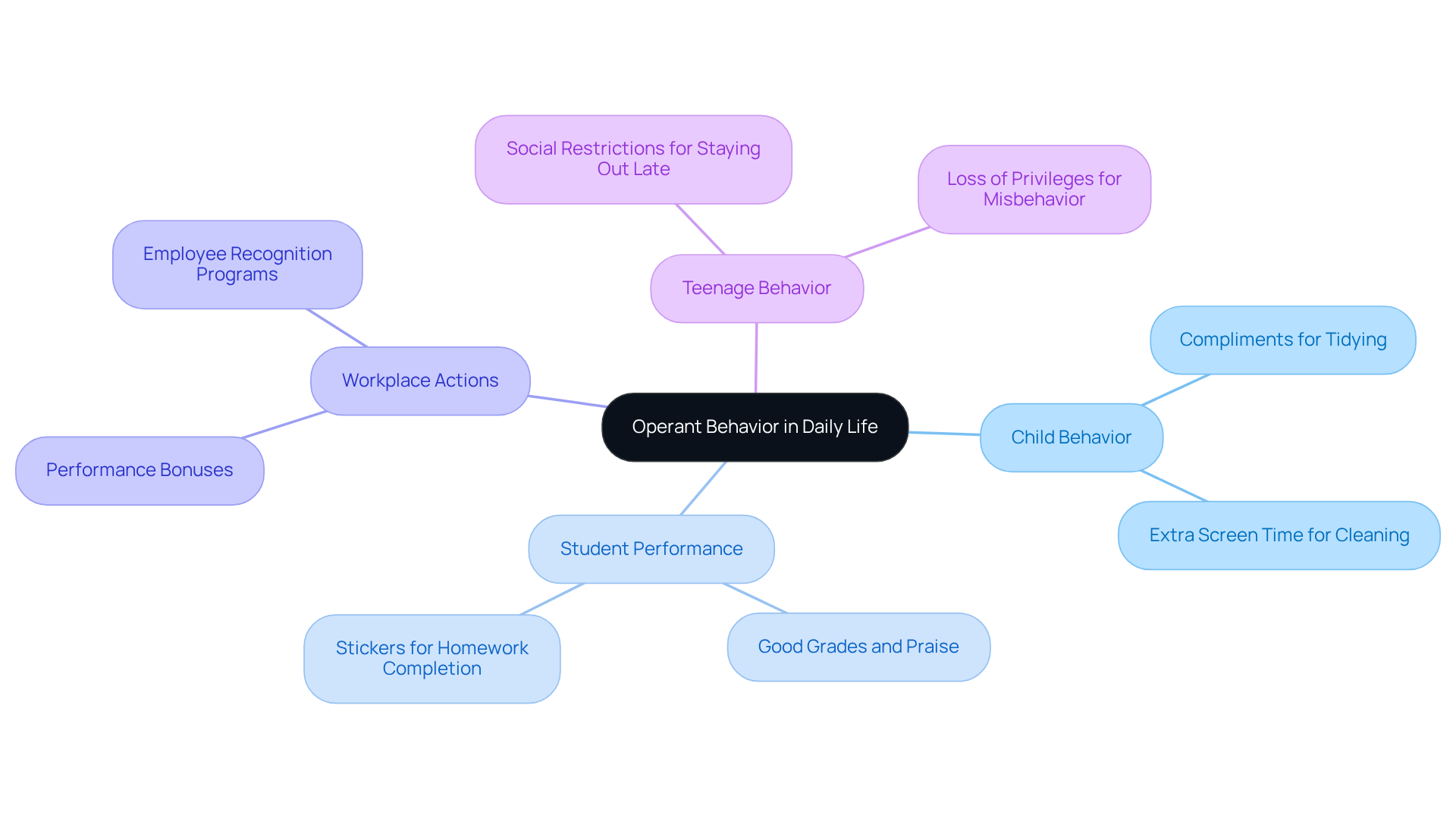
Operant actions significantly influence learning and in everyday situations. Consider this: when a child tidies their space and receives compliments from their parents, that encourages them to repeat the action in the future. Research indicates that students often earn good grades, praise, and gold stars for excelling on tests, showcasing the power of in educational settings.
In the workplace, an employee who consistently meets performance targets may receive a bonus, reinforcing their dedication and hard work. Conversely, if a teenager stays out late and faces restrictions on their social activities, . B.F. Skinner famously stated, "," underscoring the vital role of in shaping actions and decisions across personal and professional realms.
These examples highlight how not only but also cultivates a supportive environment, leading to enhanced outcomes in both child development and workplace productivity. Are you ready to leverage the power of operant conditioning in your own context?
Understanding operant behavior within the framework of Applied Behavior Analysis (ABA) is essential for professionals aiming to influence and modify behavior effectively. Did you know that the demand for Board Certified Behavior Analysts (BCBAs) is skyrocketing? This highlights the critical need for skilled professionals in the field.
Operant behavior emphasizes how voluntary actions are shaped by the consequences that follow them. Reinforcement and punishment play pivotal roles in behavior modification strategies. By grasping these concepts, you can enhance your hiring practices and ensure that your team is equipped with the right skills.
Throughout this discussion, we’ve explored various aspects of operant behavior, including its definition, historical context, and practical applications in everyday life. Key insights reveal that operant behavior is not innate but learned through experiences, underscoring the importance of reinforcement in educational and therapeutic settings. This knowledge is invaluable when considering recruitment strategies for BCBAs.
As the demand for skilled professionals continues to grow, embracing the principles of operant behavior can lead to more effective interventions and improved outcomes. By integrating these insights into your everyday practices, you can foster environments that promote positive behavior change.
Are you facing challenges in hiring qualified candidates? Consider leveraging platforms like Hire ABA to connect with professionals who can bring these essential skills to your team. This not only enhances the impact of your work in behavior analysis but also ensures that you are at the forefront of effective behavior modification strategies.
What is operant behavior in Applied Behavior Analysis (ABA)?
Operant behavior in ABA refers to voluntary actions that are shaped by their consequences, such as reinforcement or punishment, which influence how individuals respond to their environment.
How do learned responses differ from reflexive actions?
Learned responses, unlike reflexive actions, are not innate; they develop through interactions with the environment and are influenced by experiences of reinforcement or punishment.
Can you provide an example of operant behavior?
An example of operant behavior is a child who learns to say 'please' to obtain a cookie, demonstrating how behavior is influenced by the positive outcome of receiving a treat.
Why is understanding operant behavior important for ABA professionals?
Understanding operant behavior is crucial for ABA professionals as it enhances their ability to implement effective behavioral interventions and manage conduct in various settings, such as educational environments.
What is a practical application of operant behavior in a classroom setting?
A practical application of operant behavior in a classroom is a token economy system, where students earn tokens for positive actions that can be exchanged for rewards, reinforcing desired behaviors.
What is the current demand for Board Certified Behavior Analysts (BCBAs)?
The demand for Board Certified Behavior Analysts (BCBAs) is on the rise, highlighting the importance of skilled professionals in shaping effective behavioral interventions.
How can understanding operant behavior enhance recruitment strategies for ABA professionals?
Understanding operant behavior can enhance recruitment strategies by ensuring that teams are equipped to foster meaningful behavioral change, making it easier to identify and hire qualified BCBAs.
What platform is suggested for recruiting ABA professionals?
Hire ABA is suggested as a reliable platform for recruitment that connects organizations with top talent in the field of ABA, focusing on reliability and expertise.
Our expert recruitment strategies and AI-driven sourcing ensure that you receive top-notch candidates quickly, without compromising on quality. Whether you’re looking for BCBAs, Clinical Directors, or RBTs, we’ve got you covered.


